


 Filtres

by Le Pressoir
If you’ve ever passed through Val-des-Monts, taking route 366 towards Lake McGregor, you’ve surely had the pleasure of catching a glimpse of the work of sculptor Béla Simó and his life and creative partner Angèle Lux. It’s here, in this majestic studio garden, that this artist duo works and exhibits, endowing the Collines-de-l’Outaouais landscape with monumental works that fuel the imagination. Born in Romania, Béla honed his skills in Austria under the wing of renowned sculptor Josef Elter. This was followed by stays in Toronto, the Yukon and Newfoundland, before finally settling in the Outaouais region in 2013. For her part, multidisciplinary artist Angèle, originally from Montreal, came to our region to raise her family and pursue her practice. It was here that their paths crossed, and they began a long and collaborative career spanning the visual arts, photography and the literary arts.
Since then, their prolific careers have led them to exhibit widely, garnering awards and praise here and abroad. Notably, last December, the artists traveled to Lecce, Italy, where both participated in the visual arts biennial L’Ère des dieux, at the Must gallery, in addition to receiving the Medusa International Prize for Visual Art and the Cesira Doria Ferrari Prize for Poetry and Literature.
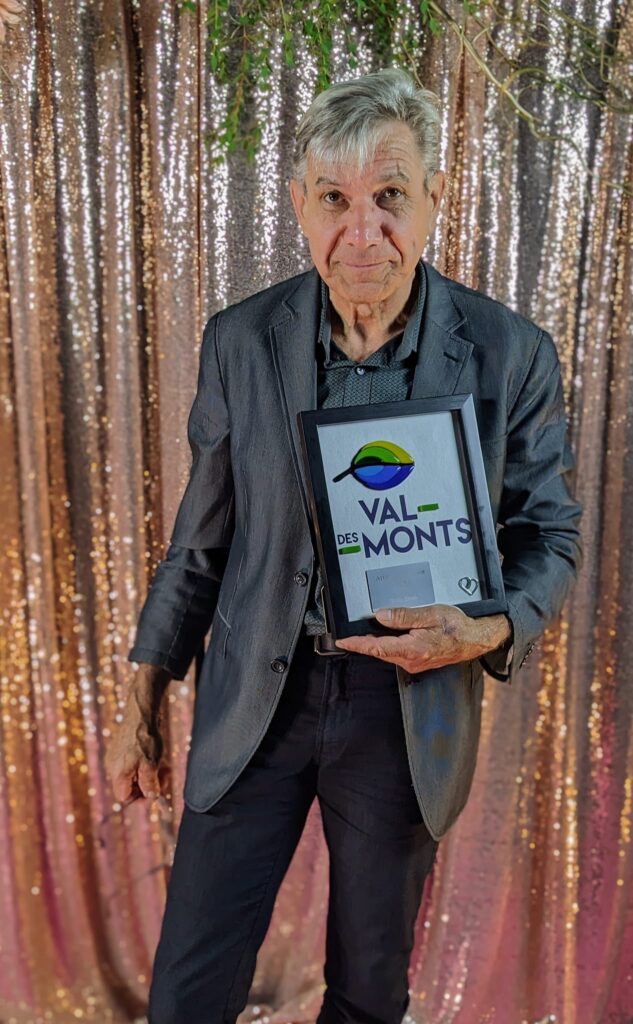
Béla was recently crowned honorary artist of the Arts visuels de Gatineau spring exhibition and named “Artist of the Year” at the Gala Distinction Val-des-Monts. He will also be the guest artist at Jardin Moore, in Mascouche, for the 8th edition of Sculptures au jardin, to be held from June 21 to October 2, 2024, where last year he won the 1st Prix Desjardins in sculpture. Angèle will also be exhibiting three of her sculptures.
As for Angèle, in addition to the Cesira Doria Ferrari prize, she won 1st prize in the 15+ category of the Low Down to Hull & Back News storytelling contest. You can also discover one of her haikus in Hélène Leclerc’s collection Le plus petit poème au monde, recently published by Éditions David. Finally, you can view her diptych Migration I and II at the Centre d’exposition Napoléon-Bourassa, in Montebello, as part of the group exhibition FemmExpo 2024, on view until June 2nd.
In this interview with the two artists, we explore their reasons for moving to the Outaouais, the nature of their collaborative practice, their relationship with the Val-des-Monts artistic community, and their wishes for the Outaouais cultural ecosystem.
You two aren’t originally from the Outaouais region, so what influenced your decision to settle here? And Val-des-Monts specifically?
Angèle: In my case, I left New Brunswick, where I’d settled after studying journalism and teaching, because my partner at the time didn’t like it there. I wanted to move to Montreal and live and work in French; he wanted to move to Toronto and live and work in English. We compromised and opted for Gatineau. We later moved to Val-des-Monts to offer our daughters a better quality of life. They’ve left the nest now, but I like it here. It’s a peaceful and inspiring environment in which to create.
Béla: I also end up here because of an ex-spouse. I lived in Whitehorse, Yukon, for 18 years. It was paradise for me. My partner at the time, a pianist originally from Newfoundland, had enrolled in an ethnomusicology program offered in that province. She also wanted to be closer to her family. So, we moved there. After a few years, we realized it was a mistake for both our careers and opted for Ottawa. It was while looking for a place to build a workshop that I discovered Val-des-Monts.
Béla, you were recently named Artist of the Year at the Gala Distinction Val-des-Monts, congratulations! How does recognition from your community add to your sense of belonging to your municipality?
Béla : Being named Artist of the Year is a public validation of the importance of my artistic contribution to the municipality. It means that the community recognizes the value of my artistic work and its impact on cultural life. So it’s certain that feeling supported and encouraged by the community strengthens your attachment to the place where you live and work. But it’s also important that this support takes concrete form. The municipality of Val-des-Monts needs to support its artists and artistic creation on its territory. It needs to create a link with them, thereby strengthening its commitment to cultural development and contributing to a more vibrant and enriching community for all. In my opinion, there’s still a long way to go…
What would you like people to know about Val-des-Monts’ cultural community?
Béla : I’ve been told that Val-des-Monts is the MRC municipality with the largest number of artists on its territory. They cover a wide range of disciplines, including visual arts, music, dance, literature and poetry, theater, photography, and crafts. But they are seldom seen or heard. There is also an exodus of cultural workers. Although a cultural policy has been adopted by the municipality in 2021, are we really managing to support and stimulate creators in their artistic development? Do we really offer them a living environment conducive to creation and a showcase for expression, performance, and exhibition? It’s true that the municipality funds cultural events such as the Festival country de Val-des-Monts and the annual Arts-aux-Parcs exhibition, but I don’t think these events really highlight the work of local artists. Showcasing a handful of local artists once a year during the Journées de la Culture is too little. We need more vision. Because an artist’s motivation is often a function of the support and appreciation they receive. Without motivation, there is no passion, and without passion, there is no art…
You’ve been working together for a long time, but you both have well-established solo practices. What dictates what becomes a collaborative piece?
Angèle : Convergence of ideas and artistic visions, as well as mutual inspiration, are probably the main factors. There have also been times when our collaboration has been fueled by the inspiration we draw from each other’s artistic practices. For example, Béla was inspired by one of my digital creations and this led to a collaboration where we integrated my concept into a sculpture. The complementary nature of our skills is also an important factor. We enrich each other’s skills and create works that neither of us could have done on our own. Finally, our artistic collaboration is based on mutual trust and open communication. We can share our ideas, give and receive constructive criticism, and work in tandem to realize our vision.
How would you describe your collaborative process?
Angèle : In our case, we complement each other perfectly. First, let’s mention that managing social networks, writing calls for briefs, public relations and communications work, billing, accounting, and inventory management all fall to me. That’s my strength. Béla’s strength lies in logistics, work ergonomics, materials management and purchasing, planning, as well as his technical knowledge and manufacturing experience. In fact, he has manufactured several of the tools and equipment we use in the workshop. We work together on ideation. The welding work is done entirely by Béla, but I’m involved at every stage of the process through my observations. I also work physically on the work (tracing, cutting, grinding, painting, etc.). Finally, I bring a more feminine, fluid element to his work, while he brings me his mastery of metal, fabrication, and sculpture. Everything is done by us in the workshop: no subcontractors or use of a machine shop.
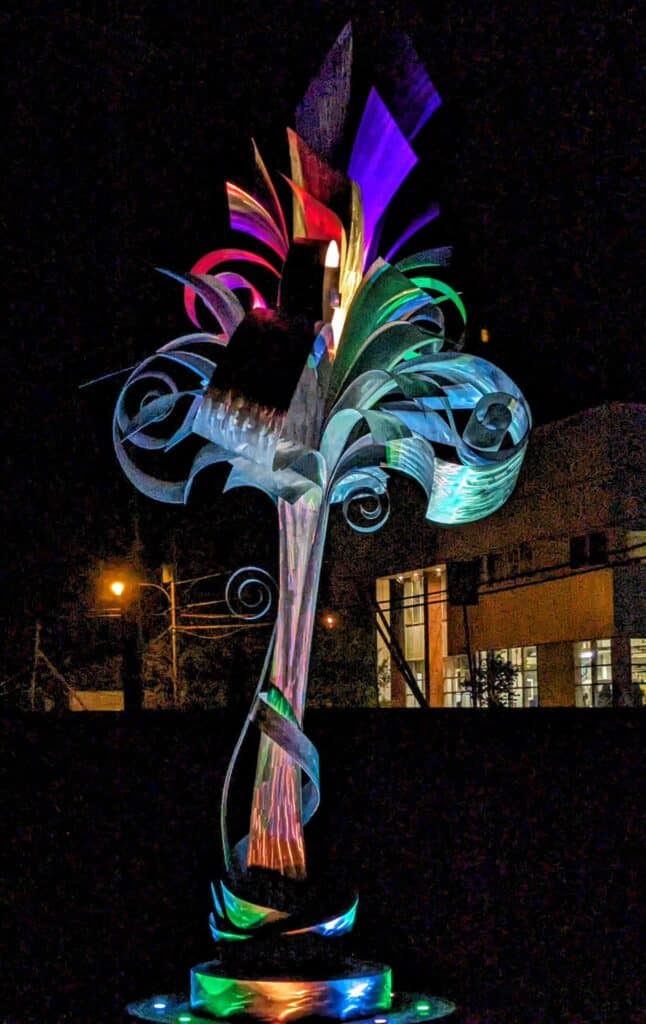
We’ve inaugurated a new public work in Buckingham, can you tell us about it? Was it created specifically for this location?
Angèle : Flots, a brushed aluminum sculpture, is a stylized and poetic representation of both a tree and a water jet. The public artwork commemorates the Lièvre River, which forged Buckingham, and reminds us of the importance of the forest in its development.
Béla : A series of smaller sculptures based on the same concept appear in our sculpture garden, an experiment in how to harmoniously attach metal strips to a trunk. Time after time, the pattern became more complex, and the sculpture grew in height and width. An animated prototype was then produced for the Buckingham commemorative work’s call for briefs. Flots was born of this evolution but is still a sculpture customized specifically for R. W. Scullion Park. It measures almost 5 metres in height. With its modular, programmable LED lighting, we wanted it to reveal the magic that can arise when art invites itself into a park.
You have a sculpture garden at home. Do you often receive visitors? Can people visit at any time?
Béla : Our sculpture garden is a landmark. It’s very popular. It welcomes some 1,800 people a year, with no admission charge. In the past, Angèle even always offered free guided tours. Some lasted up to 90 minutes, depending on visitor interest. After all, the garden boasts some 50 monumental sculptures. Now, people can drop in when we’re in the studio, or they can make an appointment for a guided or unguided tour. We like to put a smile on people’s faces and share our passion with them.
We can imagine that it’s difficult to exhibit and store our work when we’re making sculpture, what are the issues when you’re a sculptural artist?
Béla : Sculptures, especially large ones, take up a lot of space. We need to have adequate storage space to keep them safe between exhibitions or sales. This becomes a logistical and financial challenge. If sculptures are left outside, they need to be occasionally cleaned and re-waxed. Transporting monumental sculptures is also complex and costly. The works require special handling and packaging to avoid damage during transport and, in my case, to prevent the aluminum from being scratched. These precautions are even more important if the work is painted. It’s also worth mentioning that handling aluminum sheets and lifting monumental works of art during their creation can sometimes be a challenge, not to mention the fact that a monumental work requires a good-sized workshop.
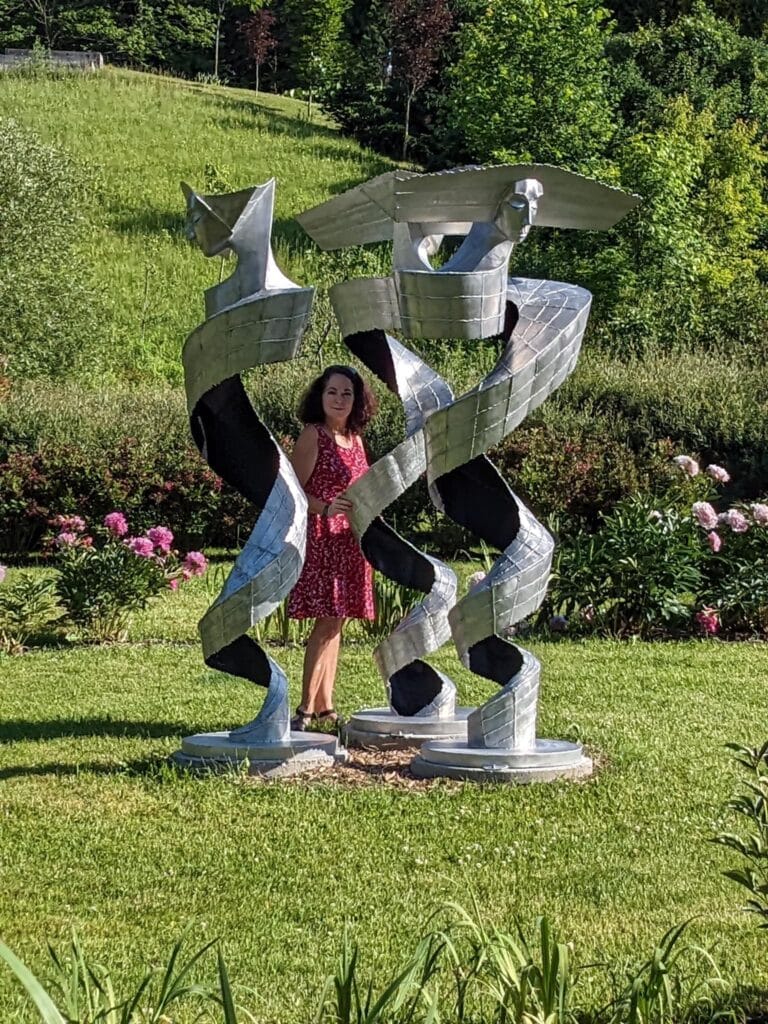
Angèle : I’d like to add that another issue is the cost of production: creating sculptures like the ones we make is costly in terms of materials, tools, and time. Marketing them is also more complex than other art forms, as they often require physical interaction with the work to fully appreciate its three-dimensional dimension. Photographing the works is also more difficult, as aluminum is a highly reflective material. Finally, large-scale sculptures can pose problems of accessibility, i.e. you must consider the size of the venue. I’m constantly reminding Béla of this last constraint when he designs his work. For example, one of his sculptures could not be exhibited at the Espace Pierre-Debain because of the height of the ceiling and the fact that there must be at least 30 cm between the ceiling and the work.
Angèle, you navigate between the visual arts, text, and photography. How has your creative process evolved over time? What dictates your choice of medium?
When I first started out in the visual arts, I immersed myself in painting and mixed media. I was fascinated by the way colors, shapes and textures can communicate emotions and ideas. Then I started photographing these textures, shapes and colors, as in my series of photos of Shanghai walls. My poetry, meanwhile, was fueled by personal experiences and intimate reflections. At this stage, my three passions seemed to exist in parallel, each with its own way of expression.
Over time, my poems were enriched by the visualization and evocative images I discovered while painting. My photographs became an extension of my poetry, capturing fleeting moments imbued with emotion and symbolism. My artistic worlds intertwined. My writing has sharpened, exploring more complex themes and visual metaphors. I’d now like to create works that integrate visual, poetic and photographic elements, exploring how these different layers of expression can come together to convey deeper emotions and narratives and their intersections.
Do you have any upcoming projects you’d like to promote?
Béla : My financial situation limits the realization of my ideas for monumental sculpture. And since I have a lot of aluminum scrap, I’ve decided to start an art foundry. I already had a bronze foundry in the Yukon, but aluminum casting was new to me. So last winter, I set up my own small artisan foundry. I haven’t really had a chance to experiment, but I’m planning to cast small, more affordable sculptures so that ordinary people can buy one of my works. This will also enable me to add molded forms to my monumental, welded sculptures.
Do you have a wish for arts and culture in the Outaouais?
Béla : I wish we listened more to the vision of artists and asked their opinion on how to make a community more culturally rich. I’d also like to see more opportunities for artists like me to share their experiences with young artists, but also to learn from them. We can grow together and enrich each other.
For my part, I’m convinced that culture is a powerful economic and identity vector. Recognition of the collective impact of artists and cultural workers on our development must be part of a strong municipal and regional vision for the future. I’d therefore like to see greater support for artists by offering them decent working and practice conditions, the support they need to create, innovate, and share their work, and infrastructures to encourage artistic expression in all its forms.
I also hope that arts and culture in the Outaouais will flourish and blossom, and truly become a source of rapprochement within our community, helping to forge intercultural and intergenerational links, strengthening the social fabric, and celebrating creativity, diversity and inclusion.
There’s no shortage of leisure activities in the Outaouais, but the focus is often on sport and outdoor activities. However, the arts and culture play an important and crucial role in the fulfilment of a population, and our children are also important vectors! So, in addition to summer camps that offer a programme of sporting and recreational activities, we present to you a few summer camp options in the Outaouais region, for young and old, with an artistic flair.
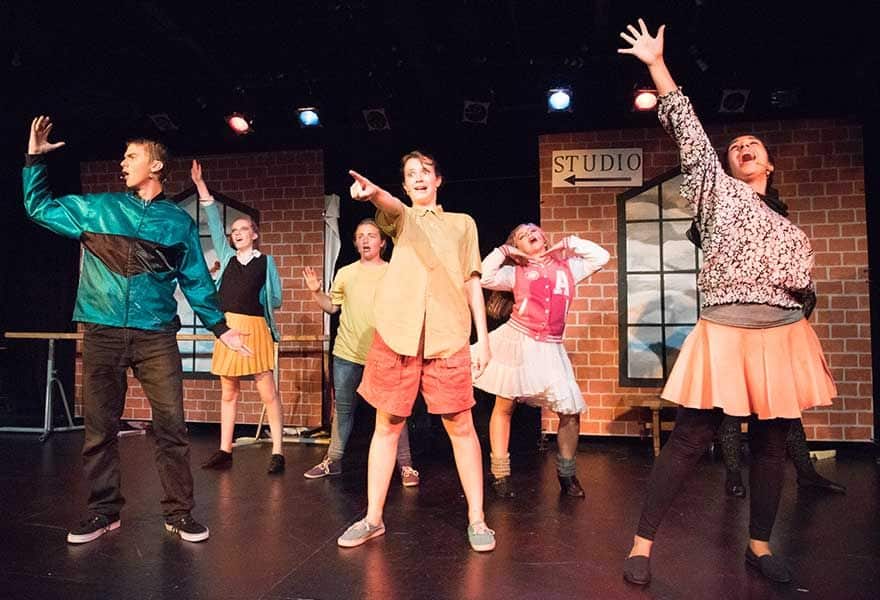
For over 20 years, many budding actors and musicians have taken part in the summer camps offered by L’Artishow. Whether they’re on the road to stardom or purely driven by their love of the stage, your younglings will be blossoming after their two-week immersion in the performing arts. Supervised by professionals in the field, participants will finish their two weeks with a final show that will show you why L’Artishow’s summer camp has become a must in the field of musical theatre.
The La Fab sur Mill cultural centre is a veritable hub for the arts in the MRC des Collines-de-l’Outaouais. With a performance hall, an art gallery, and artists’ studios, La Fab is packed with cultural and artistic activities. New this year: the ArteFab summer camp! Every week, La Fab offers a range of artistic themes and practices, from photography and ceramics, from comics to puppetry, and so much more! They also offer camps for all age groups, from children to teenagers.
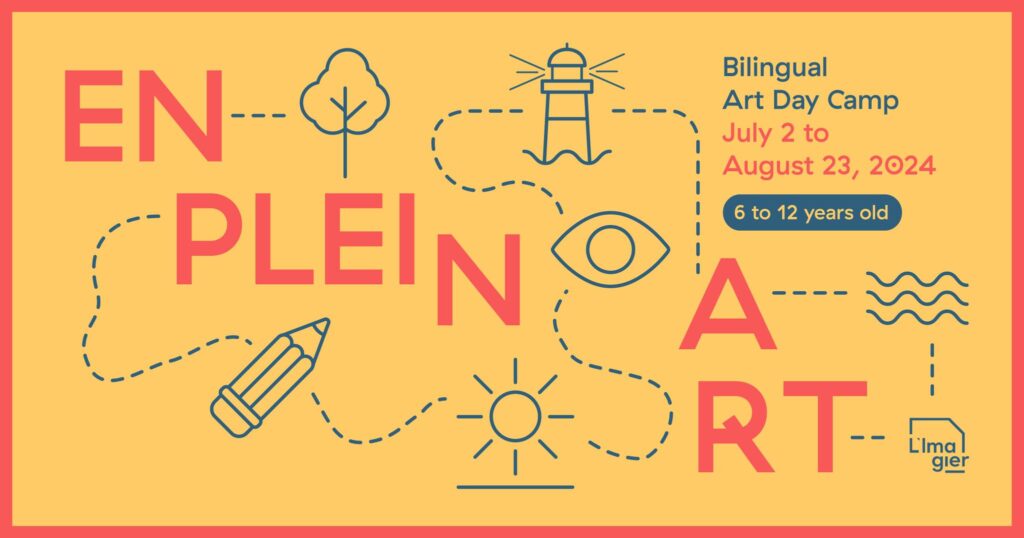
Located in Old Aylmer next to the marina, the Centre d’exposition L’Imagier is a wonderful place to discover the work of visual artists from here and abroad. Their bilingual arts day camp has quickly become one of the most popular in the Outaouais for 6- to 12-year-olds, so don’t delay if you want to sign up your kids. Each week ends with a creative art project, incorporating a variety of mediums, including collage, papier-mâché, plaster casting, drawing and natural photographic printing.
These are just some of the cultural and artistic camps in the Outaouais. Discover a selection of other camps by clicking on the links below:
The arrival of streaming completely changed the music industry in an instant. While many of these platforms, which include Spotify, Apple Music and YouTube Music, may have introduced a new era of musical discoverability and an ease of listening for the consumer, the changes to the industry have mostly been negative for a large swath of artists. For every artist hitting the top of the charts thanks to streaming, hundreds are receiving literal pennies for their musical outputs. Many music executives and label heads have managed to profit handsomely from these new technologies, but that has not been the case for the vast majority of artists creating the music found on these platforms.
“Growing imbalance between the substantial amount of remuneration received by streaming platforms, major labels, and distributors, and the revenues distributed to independent creators and labels has become increasingly apparent, exacerbating concerns from artists and creators about the possibility of building a sustainable career based on earnings from streaming.”
– UNESCO study entitled Revenue distribution and transformation in the music streaming value chain.
Many of the issues plaguing the streaming industry are hurting artists, yes, but the streaming services themselves aren’t shielded either. While their userbase is often increasing, the same can’t be said for their profits. According to a recent article by Engadget, Spotify “grew its subscriber base by 17 percent year over year” but also “posted an adjusted operating loss of $123.7 million” over that same period. Which begs the question: is the streaming industry but an increasingly precarious house of cards?
Here at Tout culture, we believe that artists are the core of the creative industry, not an accessory to it. We’re not here to shame anybody’s usage of streaming platforms, but we’re hoping people can use them in an informed and healthy way. Which is why we’ve decided to launch our new series that explores one online music initiative that’s attempting to pay artists their fair share: Bandcamp Fridays.
What’s Bandcamp?
Founded in 2007, Bandcamp lets artists and music labels decide what they feel is a just price for their music. Both an online record store and a music discovery platform, Bandcamp remains the strongest way to virtually support musicians. It offers more flexibility to artists and labels in deciding how they want their music to be presented and their pricing strategy. As a music lover you can decide to purchase their music physically, through CD and vinyl sales, or digitally via streaming and via downloads in high quality formats including MP3 and FLAC. You can also support your favourite artists by purchasing merchandise or gifting albums to friends.
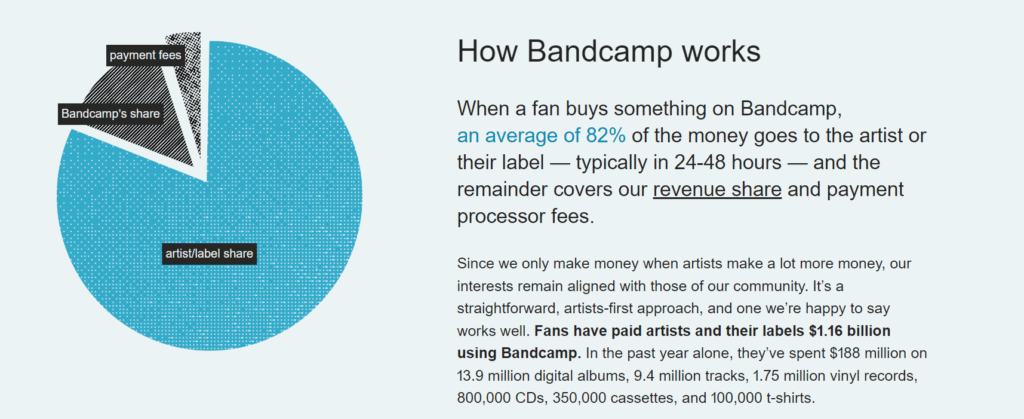
In 2022 the platform was sold to video gaming company Epic Games, known for the insanely popular online game Fortnite. What this means for the formerly independent platform is yet to be seen, but for the time being their ethos seems to have remained the same. We’re not asking you to delete your other streaming accounts, but if you haven’t yet, we encourage you to try an alternative that gives music lovers the ability to actually own their music, like we did up until recently.
Discoverability vs. Discovery
Playlists on services like Spotify and Apple Music are an extremely powerful discoverability tool for new artists. But making your way onto said playlists isn’t always easy, especially for independent artists. Also, this feature is becoming increasingly reserved to artists and labels who are willing to cut into their streaming royalties to be included in popular playlists. Bandcamp is powered by true music lovers and their online magazine Bandcamp Daily is a testament to this fact. It’s chock full of music recommendations and longform articles, written by professional music journalists, often about artists that rarely get mainstream media coverage. While the discoverability factor might not be as high as other platforms, the discovery aspect of Bandcamp goes above and beyond what their competitors are doing.
Bandcamp Fridays to counter the effects of the pandemic
When the first lockdowns started at the beginning of the pandemic, artists suddenly found themselves unable to perform live or to go on tour, their main revenue source. Bandcamp launched their Bandcamp Fridays initiative as a direct response to this new reality. Every first Friday of the month, Bandcamp committed to waiving their revenue share of all sales on that day. To date, over $100 million USD have been paid to artists and labels, many of which are independent. To find out the date of the next Bandcamp Friday, all you need to do is visit isitbandcampfriday.com to get your answer.
Each month we’ll present local artists whose music you can find on Bandcamp to help you get in tune with the local music scene as well as stimulate the local economy. Do you know an artist we should feature? Let us know! We’re always looking to discover new talent. Meanwhile, head over to Bandcamp and see if your favourite artists are using the platform, give them a follow, and maybe even buy an album.
We can feel a breath of fresh air, a sustained momentum, supporting the visual arts ecosystem in the Outaouais and Benjamin Rodger is elated. As a visual artist himself, he’s learned to wear many hats within the arts and culture community, including as teacher at the arts department at the Cégep de l’Outaouais and the president of the artist studio cooperative Les Ateliers du Ruisseau. After completing his studies outside the Outaouais region, notably at Concordia University in Montreal and in France at the National School of Fine Arts at the Villa Arson in Nice, he came back to Gatineau in 2009 to set up his practice.
With over a dozen solo exhibitions under his belt as well as close to thirty collective exhibitions here and elsewhere, his work is also contained in multiple permanent collections, including the City of Ottawa’s. Represented by the influential St-Laurent + Hill Gallery in Ottawa, his style has evolved throughout the years culminating in a distinct visual signature that combines a vivid colour palette with oversized shapes. Parallel to his artistic career, he’s occupied the role of president of a fledgling cooperative that aims to construct a new building dedicated to the visual arts that will be located on Morin Street in downtown Gatineau. This building would represent the most important cultural project for Gatineau in over 30 years, responding to the desperate needs of visual artists in the Outaouais. This project recently received the official support from the City of Gatineau Council, along with financing to the tune of close to 35 million dollars. We can confidently say the project has never been closer to achieving its objective: to create 45 individual artist studios as well as a new gallery space for the municipal Galerie Montcalm and storage for the city’s permanent collection.
We spoke with Rodger to discuss this historic achievement, explore his artistic trajectory, and delve into the cultural ecosystem in the Outaouais.
How do you feel the artistic scene has changed in the Outaouais since your return in 2009?
I believe that the changes aren’t linear but have manifested in multiple waves of successive projects that have contributed to the evolution of the visual arts scene, granted many of these initiatives no longer exist. I’m thinking notably of the performance events organized by Fait Maison, of the artist studios at Le Temporaire and L’Entre-Deux and their respective cultural programming and the visual arts component of the now defunct Festival de l’Outaouais émergent. However, I feel that we’re currently witnessing an encouraging mobilisation within the field, including the birth or advancement of many important projects. The artist and cultural worker housing cooperative, the renovation of Building 9, the extension of La Filature, and of course the Ateliers du Ruisseau, are all key projects for the region. I feel like the city is playing a pivotal role in advancing these projects, as well as other initiatives like the Culture Trail and the Place Laval.
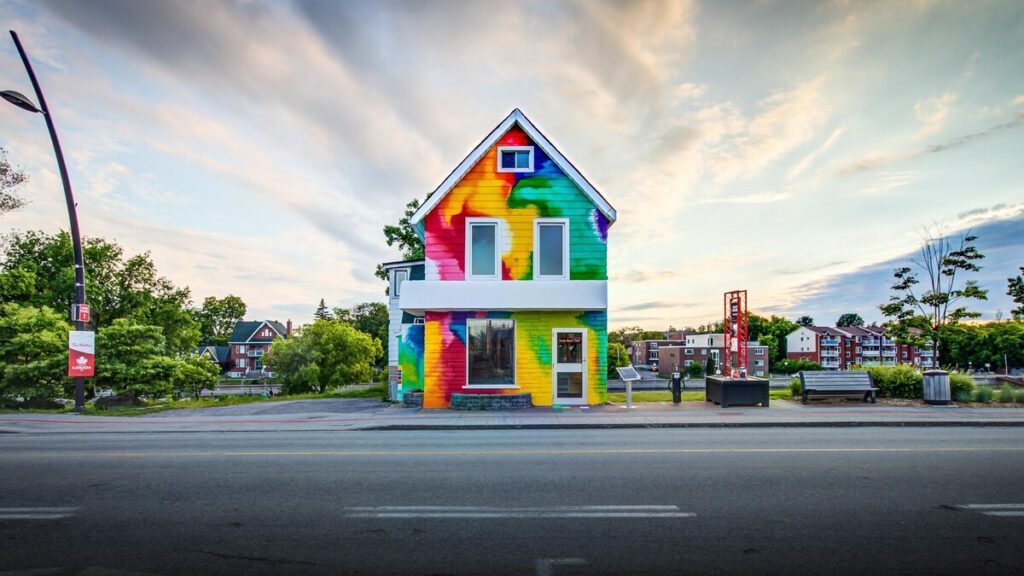
L’Entre-Deux, a building that housed temporary artist studios that recently shut down. Photo: Charles Regimbal.
Do you believe it necessary to move to a metropolis like Montreal to be a working artist?
If I believed that to be the case, I would not be here! Obviously living in a metropolis offers many advantages, including a larger variety of galleries, easier access to spaces to create, and the proximity of other artists and support networks. I know of many artists who live and work in Gatineau but exhibit elsewhere. We also have the advantage of being beside Ottawa, very close to Montreal and not that far from Toronto (where close to a quarter of all artists live!) meaning we are far from isolated. It might have been the case in the past, but the advent of the internet has really changed that reality. In the last year alone, I have had the opportunity to work for the Ontario Arts Council, based in Toronto, and have given conferences to groups of artists located across Quebec, without ever having to leave my home.
How does your work as teacher inform your artistic practice?
I often say, with a bit of a laugh, that now that I am now myself a teacher, I finally understand what my own teachers were trying to tell me as a student. Being a teacher, if I want to accurately convey technical, historical, or conceptual notions, I must not only constantly revise and update my own knowledge, but I must also keep abreast of what is currently going on in the field of contemporary arts to make sure what I teach is pertinent. I believe that my role as teacher allows me to keep learning. I’ve been at the Cégep de l’Outaouais for eight years and so many of my former students now hold bachelors or masters and are active contributors to the local artistic scene, which I love to see. Being a teacher allows me to continually invest in my artistic community and vice versa.
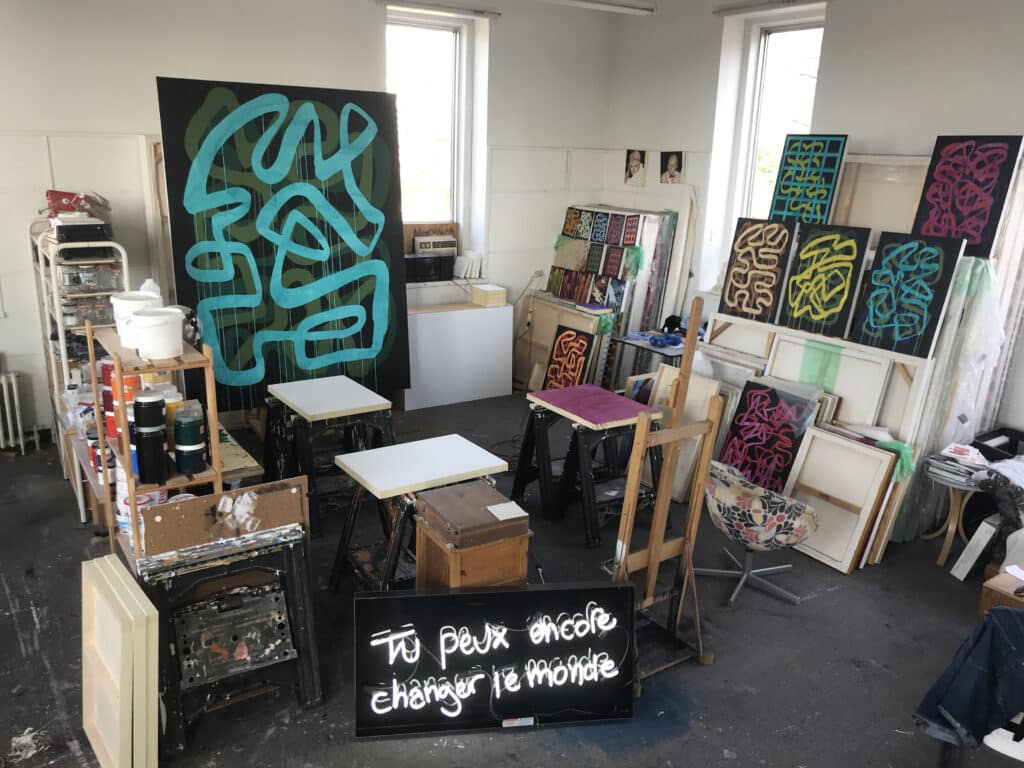
A look into the artist’s studio. Photo: courtesy of the artist.
You’ve developed a striking visual signature, how has it evolved throughout the years?
Indeed, while my practice has changed throughout the years, like going from modern-figurative to a more abstractive style, I’ve continuously explored some of the same formal aspects resulting in a visual signature that has become quite recognizable. I’m interested in the dichotomy between form and substance, colour theory and the manipulation of matter. Certain aspects of my process have a recurring theme: the motifs, lines and spots are drawn meticulously but then divided by tape and painted over with a roller. However, my subject matter is often very diverse. As an example, my series J’ai vu l’homme invisible, mais lui ne m’a pas vu explores an imagined meeting with Patrice Desbiens, who delves into the Franco-Ontarian identity in his important book L’homme invisible/the invisible man. In my series Nelligan, my work is based on the motifs found in 19th century wallpaper, era of the famous poet, when many artists only painted the faces and hands and assistants painted the rest. My series Libre circulation was all based on literary works because the exhibition took place at the same time as the Salon du livre. The series Manipulation attempted to draw parallels between the use of hands in religious paintings during the renaissance and current politics. My piece Tu peux encore changer le monde was painted as a response to a conversation with the assistant to American artists Joseph Kosuth: created in neon, his favourite medium, the piece was hung on a reproduction of the wallpaper that adorned the walls of the apartment where the conversation took place. More recently, the lines of my abstractive paintings in the series Errances are an accumulation of GPS trails of the walks I took during the pandemic.
What are some of the necessary conditions that would help artists stay in the Outaouais?
Firstly, artists need somewhere to work. Currently, there are very few of them. The temporary studios created as part of the Ateliers du Ruisseau have offered space for thirteen artists to work in downtown Gatineau. If we want artists to stay, we must offer them spaces that can match their ambitions. That is the most crucial aspect in my opinion, because a high concentration of artists becomes a lynchpin for many other initiatives. We also need more spaces to exhibit the work of these artists, of which there are currently few, including more commercial galleries dedicated to selling their work. According to the most recent numbers evoked in La Presse, Gatineau is the most expensive city to live in Quebec. Thankfully the city currently offers a grant program to help artists pay for the studio space, which is essential for most working artists. I know personally I couldn’t rent my space if the program didn’t exist.
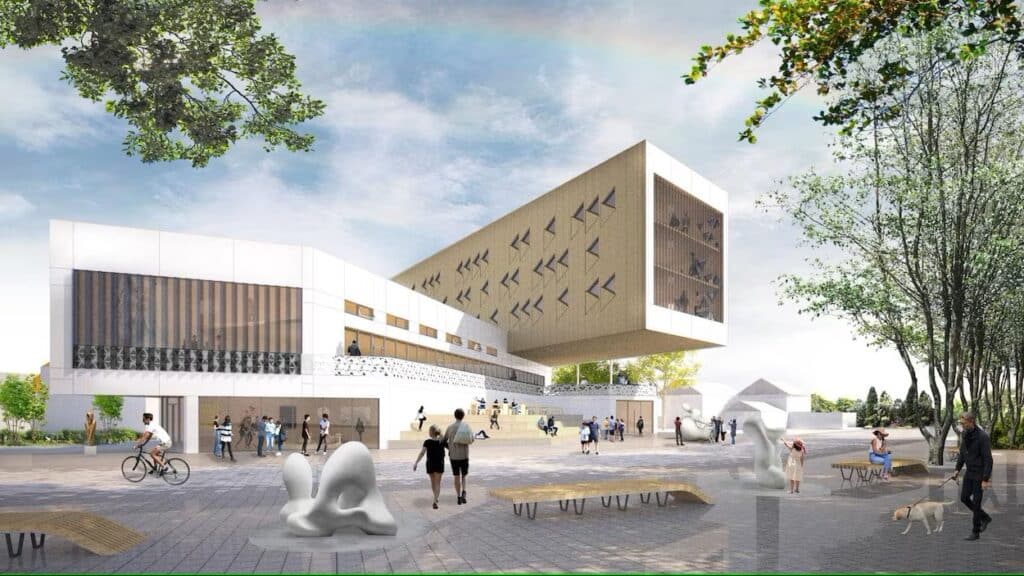
Rendering of the future building that will house the Ateliers du Ruisseau.
Speaking of the City of Gatineau, it recently announced its official support towards the Ateliers du Ruisseau project, what is the importance of such a project on the Outaouais artistic community?
It’s the most important cultural construction project for the city since we built the Maison de la culture de Gatineau over 30 years ago. It represents a major investment towards the visual arts and one of the most unique projects in Quebec and even Canada. Building such a large number of bespoke studios by and for visual artists is without precedence. The building will also be home to the Galerie Montcalm and the City of Gatineau’s permanent collection, one of the most important municipal art collections in Quebec, which bears mentioning. The fact that the cooperative will also own the building will guarantee the longevity of the project and protect the artists that will have their studios there, who are often expropriated when real estate promoters get their hands on buildings that house artist studios in other cities. The Ateliers du Ruisseau aims to create the necessary conditions to preserve our artists in the Outaouais while becoming a gathering space where visual artists, media artists and craftspeople can exchange ideas.
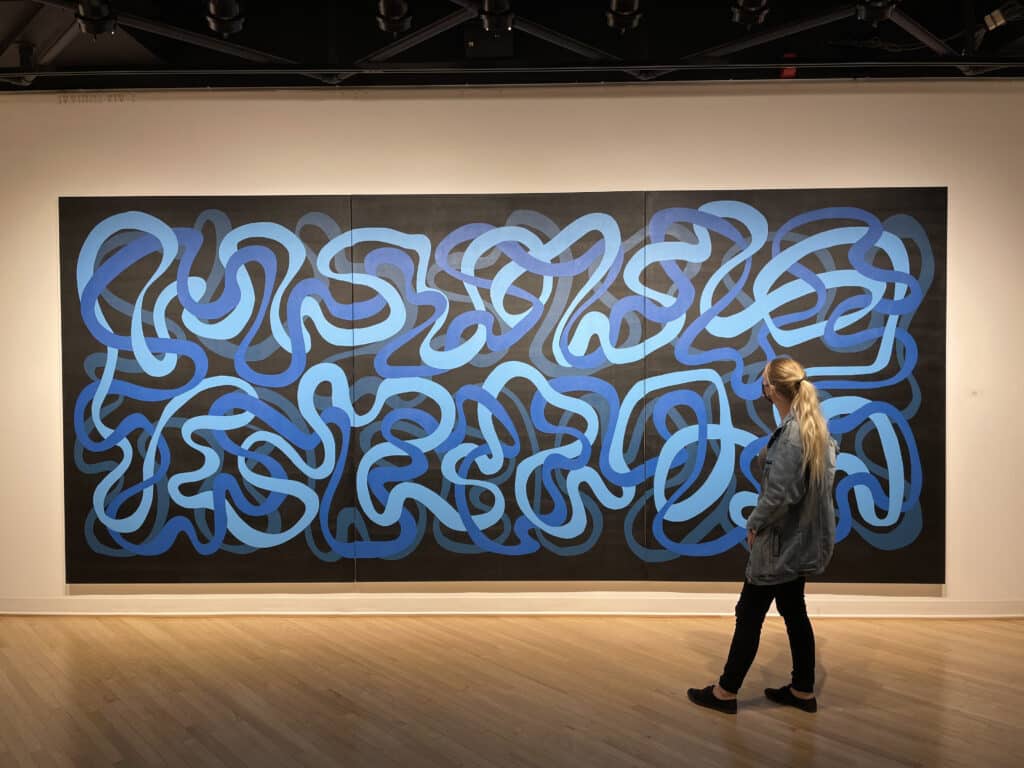
A view of the artist’s exhibition at the Galerie Montcalm. Photo: courtesy of the artist.
What is a must-see cultural event in the Outaouais this summer?
The exhibit XL presented at AXENÉO7, which ends on July 29th, is worth a visit. It’s a collective exhibit that celebrates the 40th anniversary of the artist-run centre while shining a light on the current visual arts scene in the Outaouais. Since opening in June, many activities have been organized around the exhibit, including performances, discussions, and parties, and I salute AXENÉO7 for their initiative.
One of Benjamin Rodger’s paintings is currently on view at AXENÉO7 as part of the collective exhibition XL, open until July 29th, 2023.
written by Le Pressoir
Gatineau singer-songwriter Sofia Duhaime is a rising star of the Quebec music scene who seems to be a linchpin for good news lately. Last March she signed to Montreal-based record label La Maison Mère, home to (pardon the pun) other artists such as Sarahmée and Léonie Gray, fast-tracking her career to levels beyond her 20 years of age. Following a nomination as Best New Artist at the 2023 Capital Music Awards, she’s recently been announced as a semi-finalist at the Grand Concours Hydro-Québec du Festival international de la chanson de Granby, where she’ll be battling out on stage against 23 other emerging artists next August. Finally, she’ll be opening up the show for the Fête nationale du Québec in Gatineau alongside 2022’s ADISQ Revelation of the Year Ariane Roy and Quebec musical icon Paul Piché.
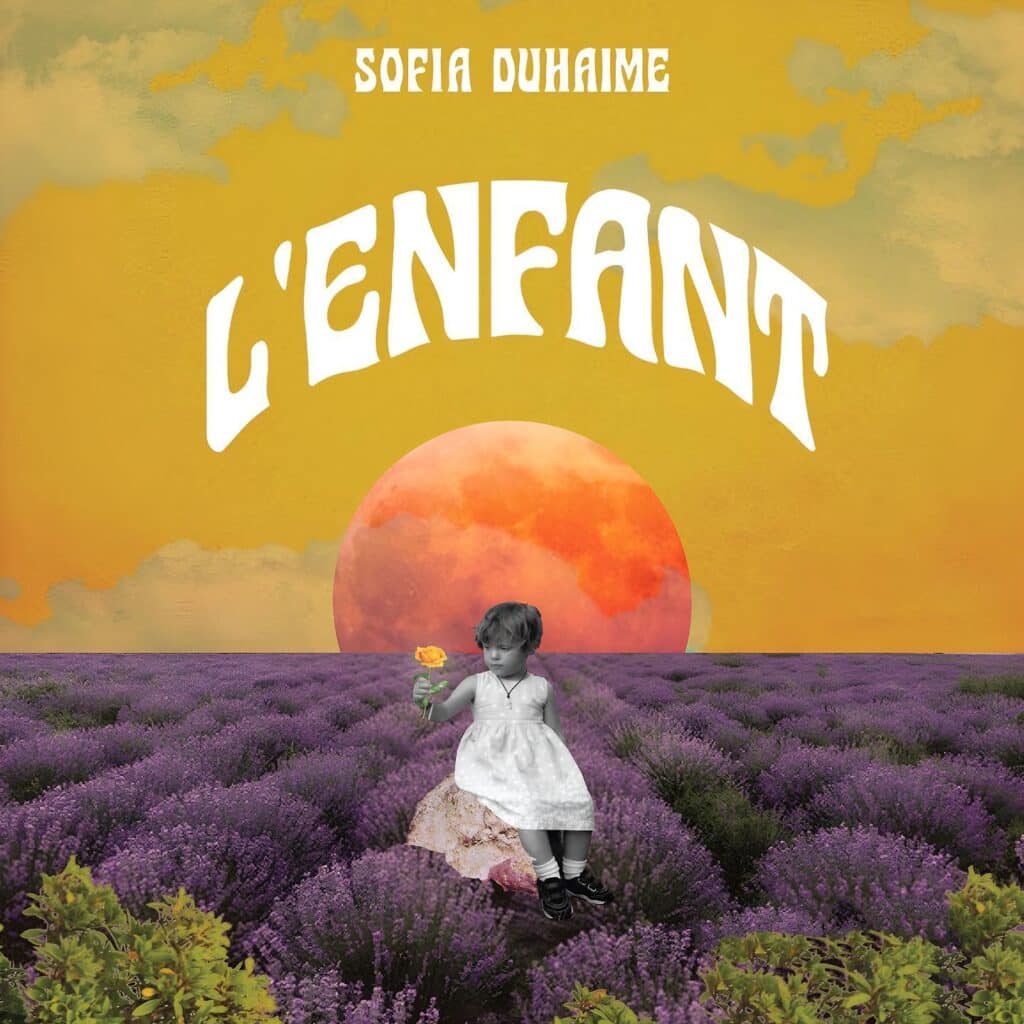
All this not even a year after launching her debut EP L’enfant, released in October last year, as well as her commanding performance during the 29th edition of the famed music contest Ma première place des Arts in Montreal. Sharing her time between Montreal, where she’s currently completing her studies in cinema at Concordia University, and her hometown of Gatineau, the artists seems to be navigating her career and newfound fame with the ease of an industry veteran. We recently chatted with her in order to discuss the importance of her home region, the impact of her studies on her musical career, and how the cultural ecosystem of the Outaouais can continue to evolve.
What importance would you say the Outaouais has on your creative process?
Growing up in Gatineau has definitely impacted the direction in which I take my music. Being surrounded by the natural elements, like the Ottawa River and the Gatineau Park, has deeply inspired me. It’s where I spend a lot of time, especially when I need to disconnect and take a break from the stresses of daily life. You can even hear some slight references, like in “Nature’s Daughter”, whose inspiration struck me while swimming in the river in Wakefield. Also, given that the Outaouais is very bilingual, my inspiration comes to me in both languages. Our proximity to Ottawa helps as well, offering up a whole new audience. I’ve been lucky to be as well received in Quebec as in Ontario.
As you mentioned, you write in both English and French. How do you decide which language to choose?
Honestly it’s often not my choice! While I’m proud of being a francophone artist, inspiration isn’t something you can control and as such sometimes my lyrics come to me in French and sometimes in English. My English has greatly improved and because I live my life in both languages, it also means it’s natural my songs should be in both languages as well. I believe it has enriched my writing and widened my scope of inspiration. Basically I never really decide a head of time and just accept the language in which the lyrics come to me. I have yet to write a bilingual song though, but I’m open to it!
How have your cinema studies impacted your musical output?
I’ve always touched many different artistic mediums, often simultaneously. For me, music and film make for a perfect duo. When I write a song, I’m often imagining a visual narrative and so I usually already have ideas for music videos or photoshoots. Studying cinema has opened me up to so many different stories, emotions and visual imagery that often feeds my lyrical inspiration. I see them as a whole, two mediums that come together to tell a story. I would love to create music videos that will come support and complete the storytelling of my lyrics.
How significant is it for you to be playing the Fête nationale in Gatineau, and what are some of your fondest memories of this celebration?
Very!!! It’s an immense honour and an amazing opportunity for me to play in my hometown for such an important event. I honestly couldn’t believe it when I received the offer to play with Ariane Roy and Paul Piché, two artists I deeply admire. As a spectator, I’ve always loved going to see the St-Jean Baptiste shows. The atmosphere is electric! I remember playing a tiny stage in Aylmer for the St-Jean Baptiste celebrations 5 years ago, Sofia that was in secondary 4 would be freaking out right now if I told her where we’ve landed. It’s great to be recognised by your home region and I’m excited to represent for the francophonie and for Quebec artists.
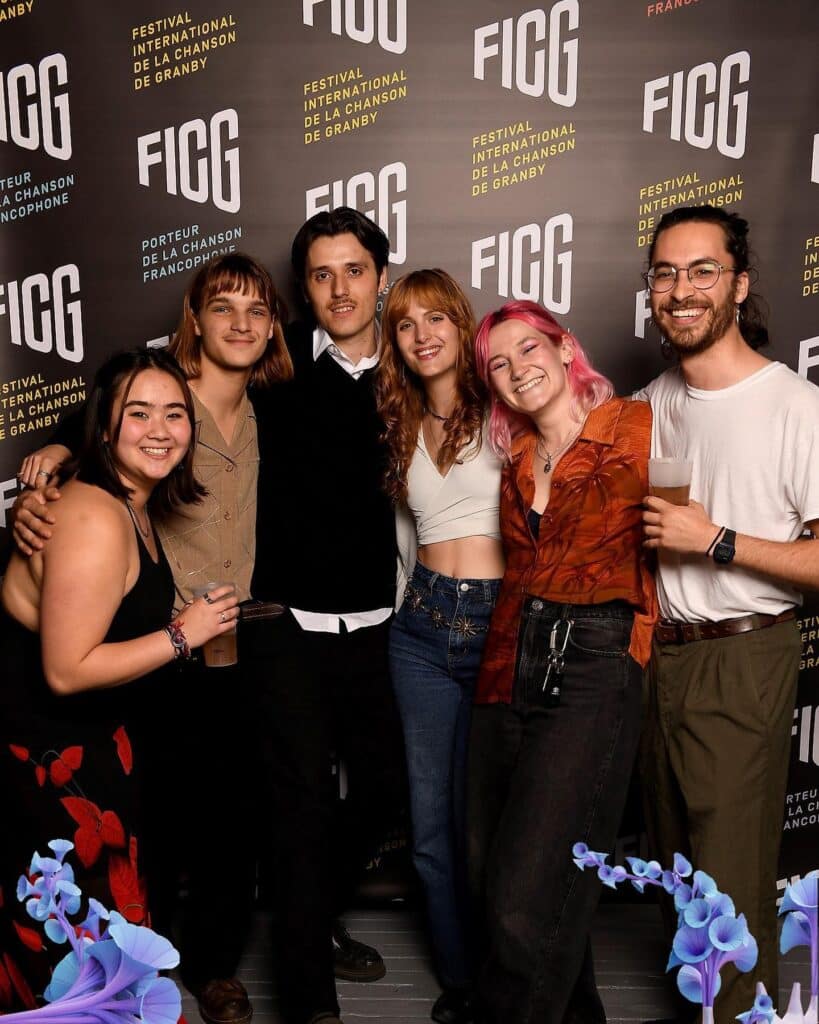
You’ve recently been announced as a semi-finalist at the Grand Concours Hydro-Québec at the Festival international de la chanson de Granby (FICG), how does it feel?
I’m absolutely chuffed to be doing the FICG this year. I’d auditioned for the first time last year and didn’t make it, but I’d received amazing feedback. Since then I did a dozen shows, released by EP and gained a lot of confidence and experience. So I was both very happy and a little surprised when I learned I’d made it this year. It was like a confirmation that all my efforts had been worth it. We spend an amazing first week in Granby to meet with all other other semi-finalists and it was a beautiful experience. Everyone is so talented, generous and kind. I can’t wait to share this experience with them, to participate in precious workshops that will help with my career and obviously, to perform on the stunning stage at the Granby Palace alongside such incredible talents.
Are there any advantages to sharing your time between Montreal and the Outaouais?
I can definitely be a lot, especially this last year, but I couldn’t ask for a better scenario. In Montreal I get to be surrounded by a bunch of musical friends and take advantage of the opportunities that only come when you’re in the heart of the action. However, I’m often in Gatineau to see friends, family and the artistic community that are still there for me. In Gatineau, I get to perform in venues that I’m deeply attached to and where I got to see many of my idols perform. The mix between home and the city keep me motivated. I get to explore the complexity of the industry with the knowledge that I’m always welcomed back home.
How would you describe the impact on your career by signing with La Maison Mère?
I’m honestly too excited about what we’re working together at La Maison Mère. I hadn’t planned on signing with a record label so soon. But their advice and their experience really gelled with my own goals. It means far fewer false-stars and a lot less guesswork. Also, having to organise my emails, booking my own shows and dealing with all the bureaucracy was starting to really impact the time I had to work on my craft and concentrate on what I love. Thanks to their support, I can now concentrate on creating and reaching my goals. We’re working on my debut album, more shows and a bunch of other exciting projects I could have never accomplished this quickly without a team.
Are there any elements to the musical ecosystem in the Outaouais that you feel are missing our could be improved upon?
The Outaouais is really a region that’s full of support and hope for new artists. I really felt that quickly thanks to events like Secondaire en Spectacle and Cégeps en Spectacle. I’ve always felt very encouraged. However, I think it could grow even more! I’ve seen many initiatives that I hope will continue, such as the street festivals in Aylmer and in Hull. We have a wealth of artists and audiences in the Outaouais! We just need to keep investing in our communities, working together, supporting artists and making sure they’re well paid so that they don’t feel the need to leave.
What can audiences expect from you at the Fête nationale du Québec à Gatineau?
I can’t wait to perform! I’ll be performing exclusively in French, with many of my known songs but also a few new ones. I’ll obviously be accompanied by my trusty guitar and dear autoharp and hope to create a warm and inviting atmosphere. I may even pay hommage to one of our favourite Quebec artists…
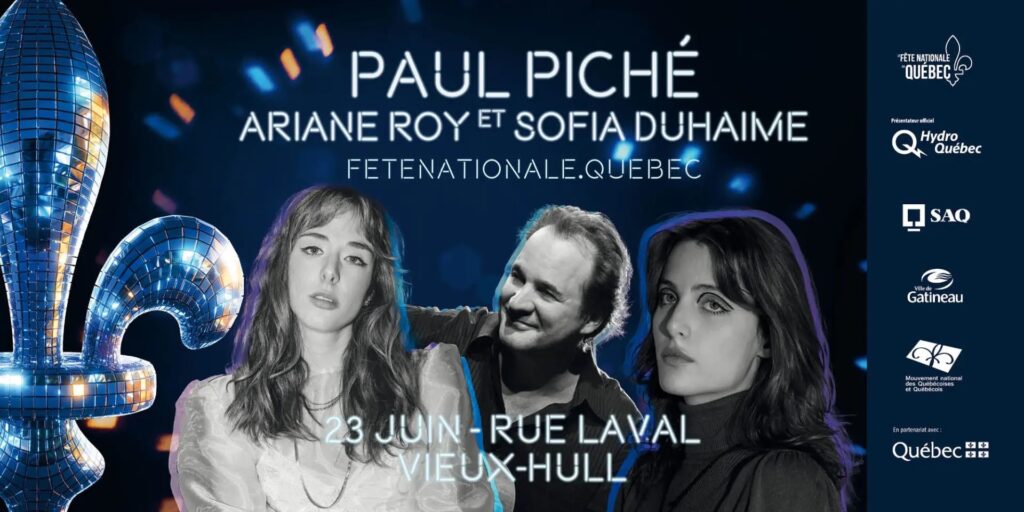
Sofia Duhaime will be performing at the free concert celebrating the Fête nationale du Québec à Gatineau Friday June 23rd in the downtown core on Laval Street with Paul Piché and Ariane Roy. Read all the details in our events calendar.